Making Strange
Exhibition Dates: September 8 - November 13, 2026
Hours: Weekdays 10am - 6pm; Weekends 12 - 6pm
Opening Reception: Thursday, September 17, 5 - 8pm
Essay by Jenn Bratovich, Chief Curator at Print Center New York
Lower East Side Printshop is pleased to announce the opening of the exhibition, Making Strange, featuring works created by the artists in Keyholder Residency ’25-26 and Summer Keyholder Residency ’26: Mira Dayal, Natasha K. De Armas, Amelia Akiko Frank, Katya Grokhovsky, Leekyung Kang, Melissa Ling, Mahalexmi Mohan and Wenfei Quan.
The very conditions of print set the stage for strangeness. Making prints requires thinking backwards, giving up control, iterating, seeing what happens. The artists in this Keyholder exhibition embrace strangeness as an aesthetic strategy: in these artists’s practices, disorientation and estrangement free us from the shortcuts we use to order our experiences and create meaning.
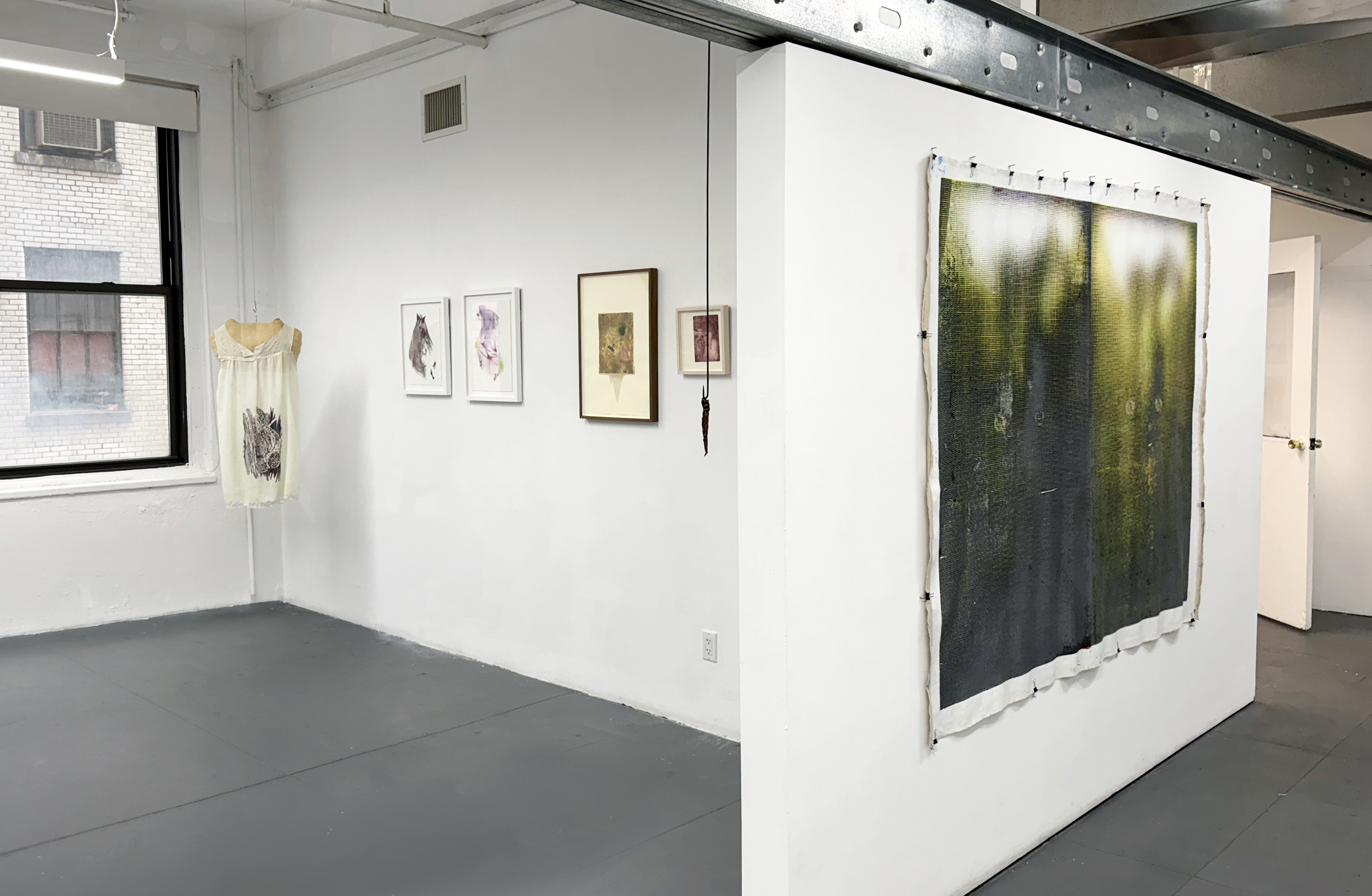
Take Wenfei Quan’s elusive, large-scale screenprints, which engage visibility and invisibility. Quan’s practice acts out an archival impulse, drawing on our online encounters with image reproduction and circulation. Her blurred images play with fields of visual textures that feel equally like pixelation, mesh, and moire. What exactly the images are of is besides the point; rather, Quan focuses on how we relate to them. Hidden beneath familiar icons that signal issues of privacy and access, these dissolving images present their illegibility as a matter of course.
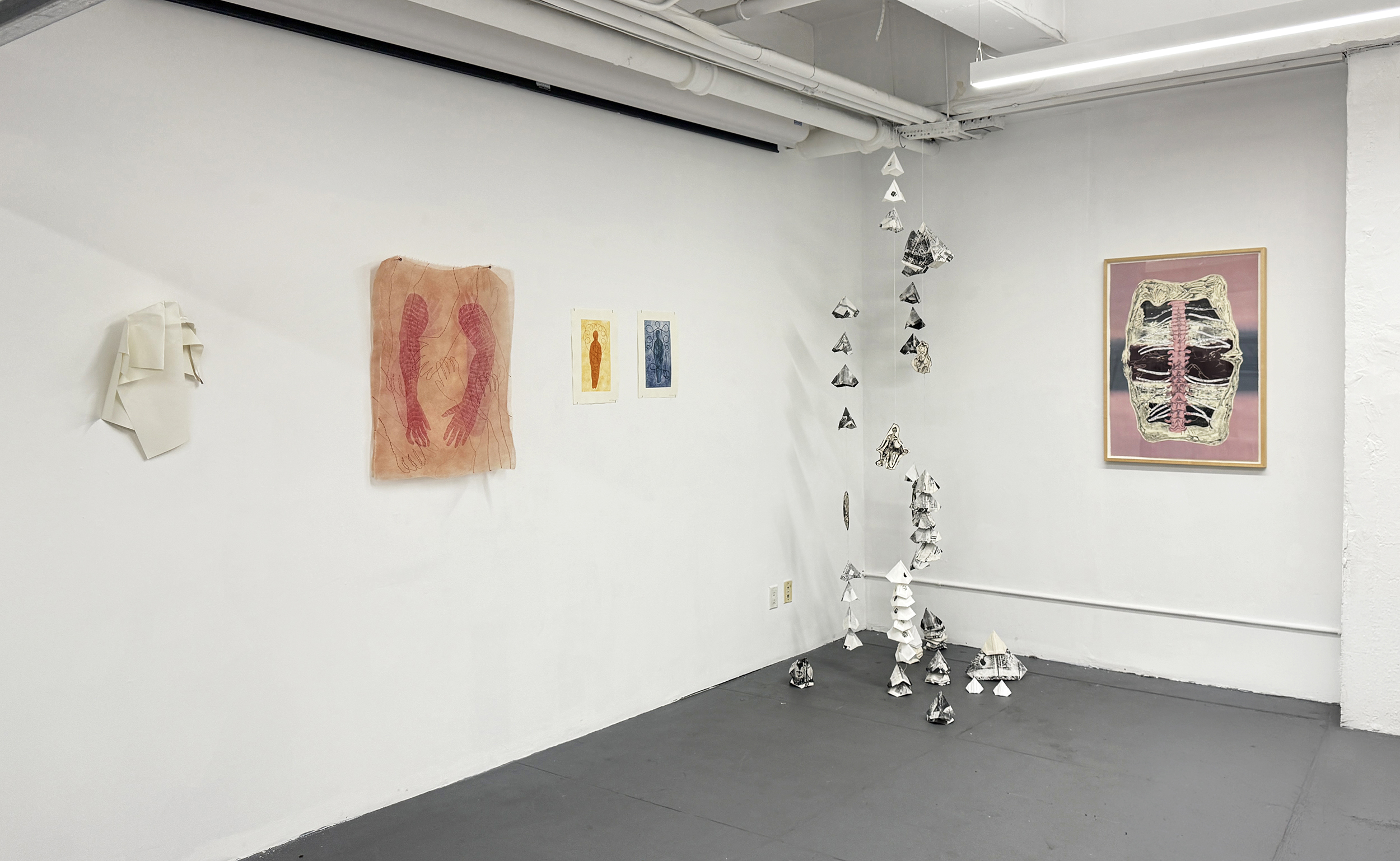
For Melissa Ling, making the familiar into the unknown (or unknowable) is a process of working through repeated acts of translation. Beginning with source images such as family photographs, screenshots, and other documentation, Ling moves through a process of accumulation and erasure to arrive at images—in this case, collagraphs that record the folds of fabric—that revel in a sometimes spooky estrangement, their meaning remaining open. Natasha K. De Armas also uses the tactile collagraph process to build her works. She collages textile materials with repetitive stitchery into abstracted bodily forms, transferring their textures with ink onto paper or onto layered scrims of silk organza. De Armas’s work on organza, Held in between, evokes both the presence and absence of the body at once, playing with flatness, tactility, opacity, and translucency.
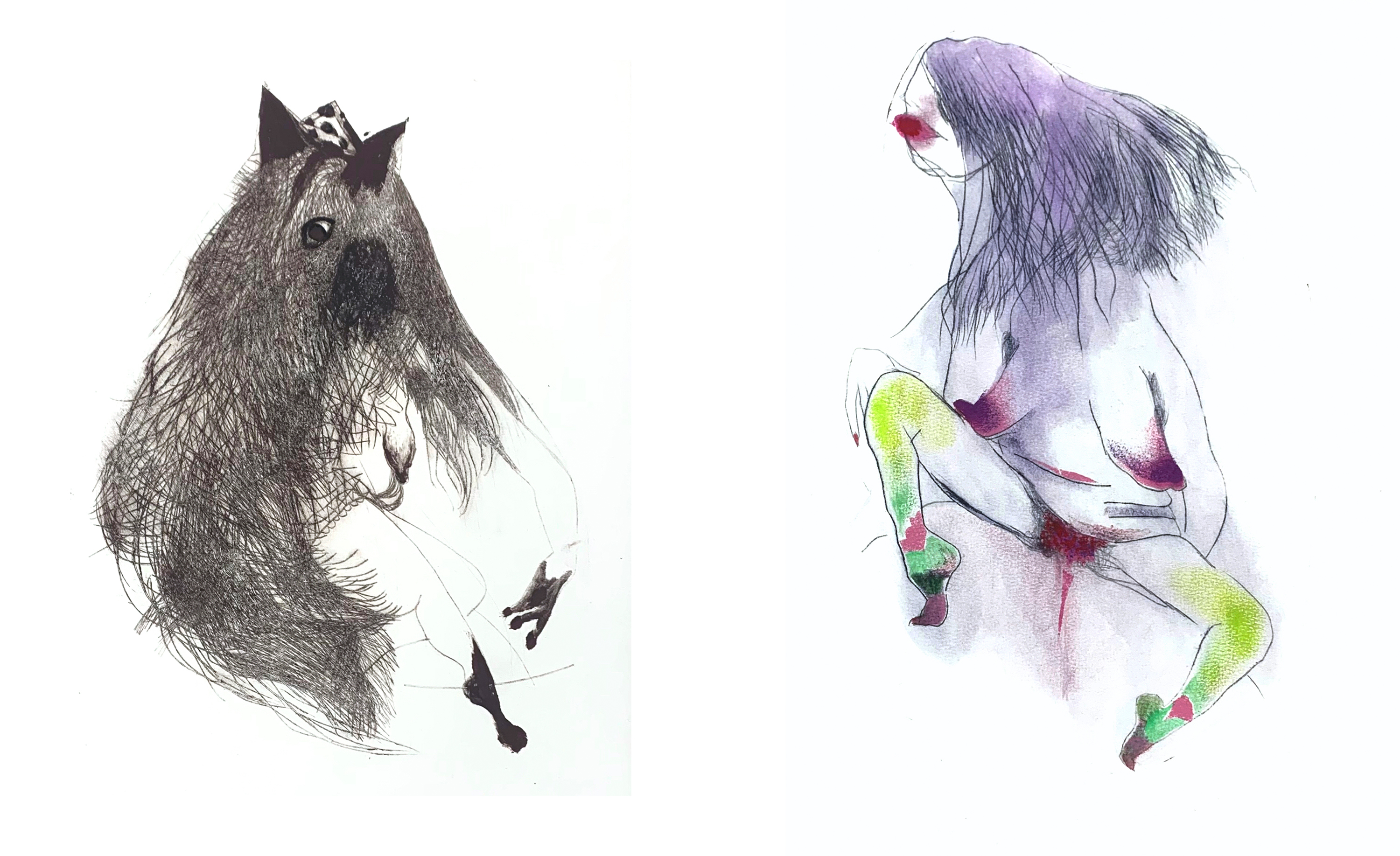
Katya Grokhovsky also explores in the corporeal, transforming the female body into something hybrid, grotesque, and monstrous. In a free and unstudied gesture, Grokhovsky renders unruly bodies that are impossible to totally resolve. Here, the female body is made strange: it becomes what Grokhovsky calls a “complex, contradictory, and ever-shifting site” for the desirous, the absurd, and the abject. In Leekyung Kang’s body of work The buried world does not stop, the artist builds an esoteric world around a central altar-like image made in monotype, screenprint, and drawing. Structured like a torso with ribbons of text unfurling like ribs out from the spine, the work gestures to the earth, the cosmos, and the cycle of life. Kang is interested in the transformative potential of thresholds: between seen and unseen, above and below, here and beyond.
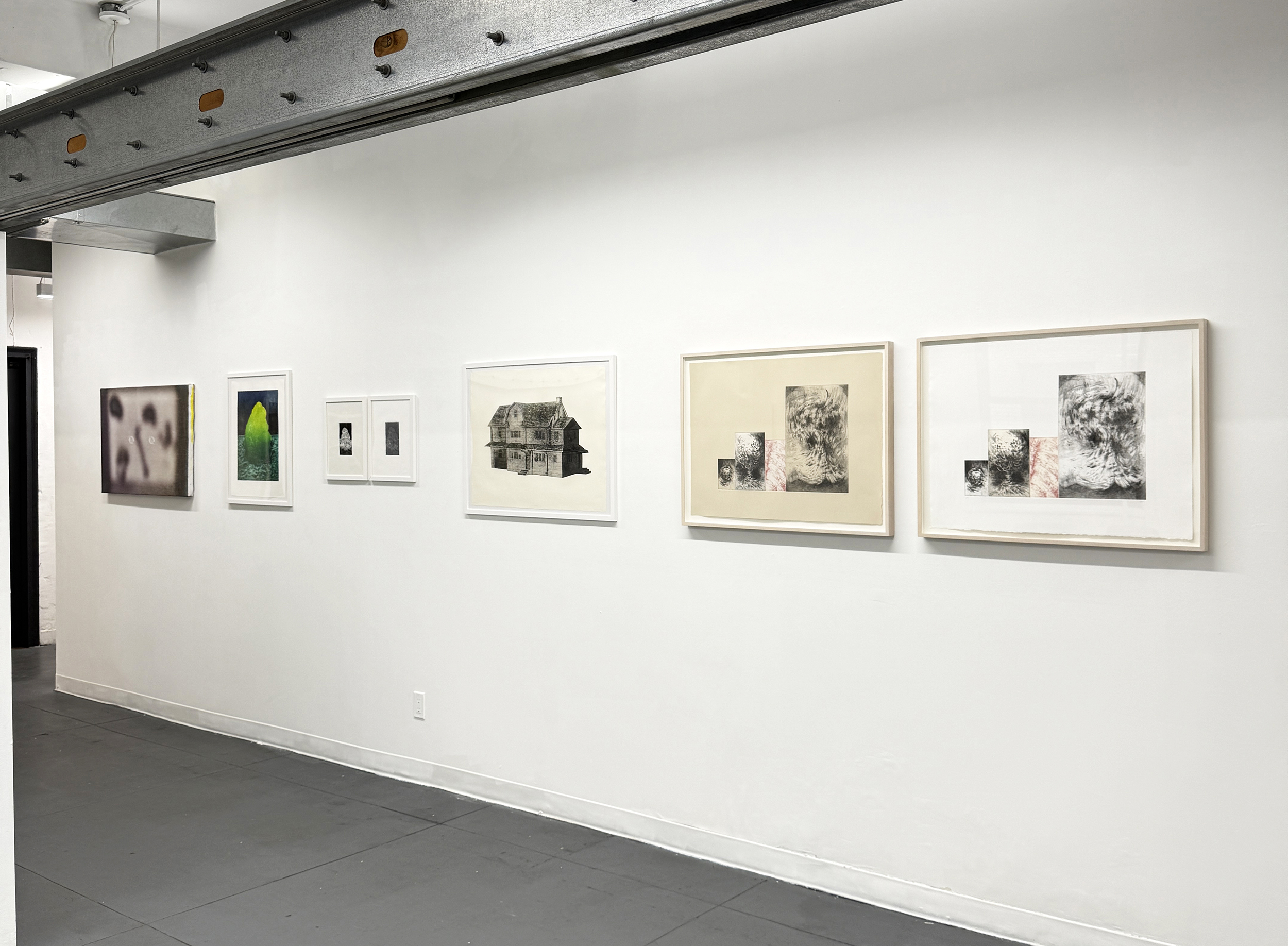
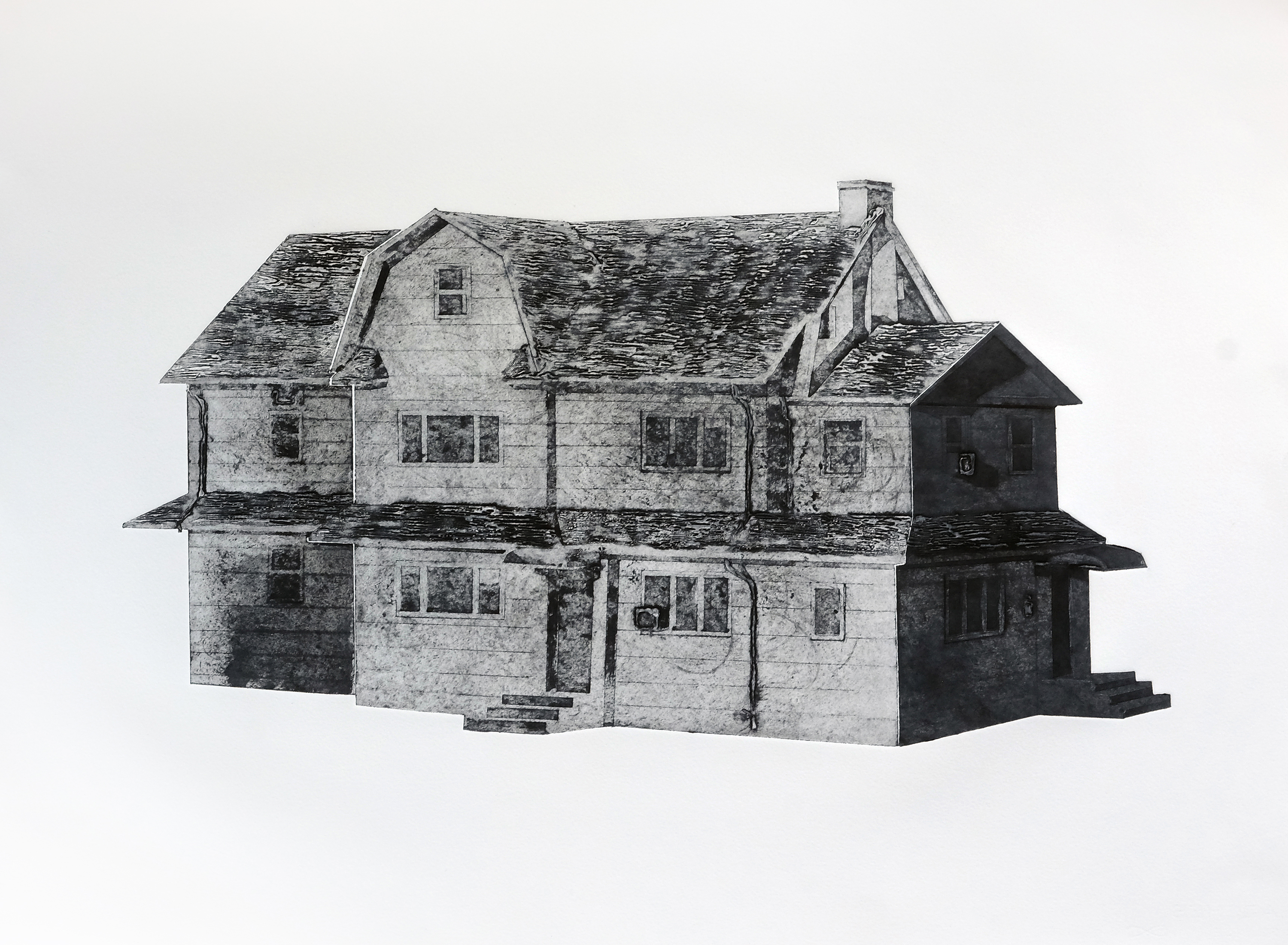
Multiple etching and drypoint plates are the building blocks of Amelia Akiko Frank’s work. Here, Frank forces the plates into a conversation by juxtaposing their discrete and seemingly disjointed images. Her swirling mark-making reveals an apple, a field of patriotic stripes, and a hybrid tree/explosion. Gestural arrows suggest the flow of people, ideas, or the gaze. For Frank, the images function symbolically, referencing relationships between part (the individual) and whole (the nationstate). Similarly, Mahalexmi Mohan’s intimately-scaled drypoints are monochromatic, mysterious exercises in the artist’s visual lexicon—a catalog of repeating marks, gestures, and icons. weren't you with me last night? suggests architectural space and perhaps a reclined figure; thread offers line drawings of what immediately read as disembodied eyes; several works feature what might be long-stemmed flowers and a pair of amputated legs. These works refuse to resolve fully into representation: yet they nag us, tugging us toward the feeling that we recognize what we see.
Mira Dayal’s folded paper sculpture is one of several she has made using remnants of copper plates from the print shop. Dayal bent each piece of copper into a curve, then forced a piece of paper to fold around the metal shard: the result is a deeply folded sheet that cascades around the metal framework, recalling something like a mask or fabric. Yet it is neither. In Dayal’s words, the sculpture “[strains] the limits of the paper to behave as a malleable surface.” Cleverly, Dayal may also be straining the limits of how we can think about printmaking as creating a physical mark, or trace, from pressure. Like Dayal, the other artists in this exhibition stage scenarios that ask us to slow down and look more deeply. When artists make things strange, they open up our awareness to the conventions of process, form, representation, and narrative. In that transformative space, our perception of everything is more vivid.
About the Writer:
Jenn Bratovich is Acting Executive Director and Chief Curator at Print Center New York, where she uses her decade of curatorial experience to lead all aspects of the organization’s artistic programming. Since joining Print Center in 2019, she has played a key role in leading the organization through a transformational strategic plan that included a move to a new, ground-floor exhibition space in the heart of Chelsea, growing the organization’s operational and programmatic capacity, and sharpening its artistic vision. Working with invited guest curators, she has developed a program of exhibitions that have solidified the Center’s reputation for its rigorous yet accessible curatorial approach. She has also significantly grown the organization's educational and public program offerings and led development of a new exhibition and artist development program that aims to provide meaningful material, artistic, and community support to emerging artists working in print. In 2025, she launched the Center’s first open call for emerging curators.
Bratovich has previously held positions at Hunter College Art Galleries and Women's Studio Workshop. She received her BA from the University of Rochester and her MA in art history from Hunter College, where she focused on postwar practices in Europe, the US, and Latin America. Her curatorial work is informed by the idea of the exhibition as a forum for public learning and discourse, and by artist-centered approaches to both expanding histories and uplifting emerging artists. She is interested in how print, as a set of tools, processes, and strategies, is used by artists working within interdisciplinary practices. Jenn also serves on the Board of Directors at Women's Studio Workshop.